
Case Study · Applied research and platform development
TerraFed
Privacy-governed soil intelligence for collaborative mapping, sampling prioritization, and dashboard-ready MRV support.
Problem
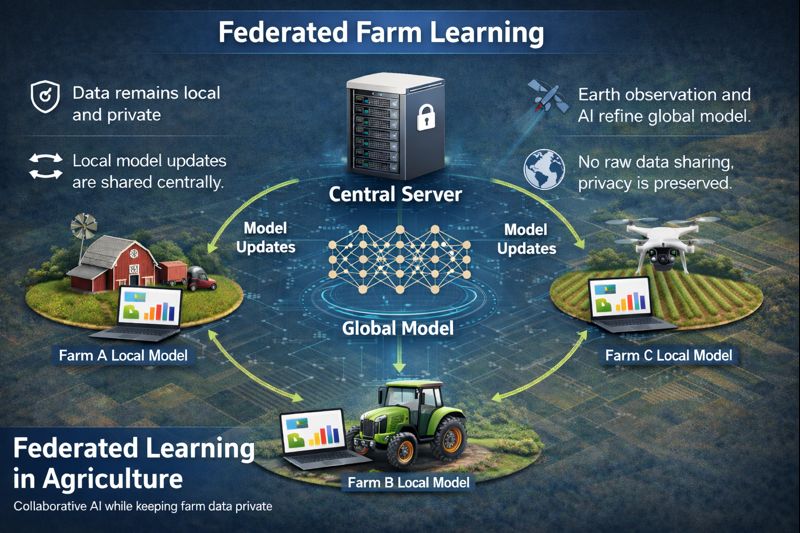
Farms and institutions may need collaborative soil models while retaining control of raw observations and respecting data-ownership constraints. A usable workflow must also move beyond model training to spatial outputs, validation, uncertainty, and stakeholder interpretation.
Role
Giannis contributes to technical development linking soil observations, spectroscopy, Earth observation covariates, federated learning, mapping, and communication outputs within a University of Florida research context.
Data and Methods
- Local soil and environmental observations
- Soil spectroscopy and documented preprocessing
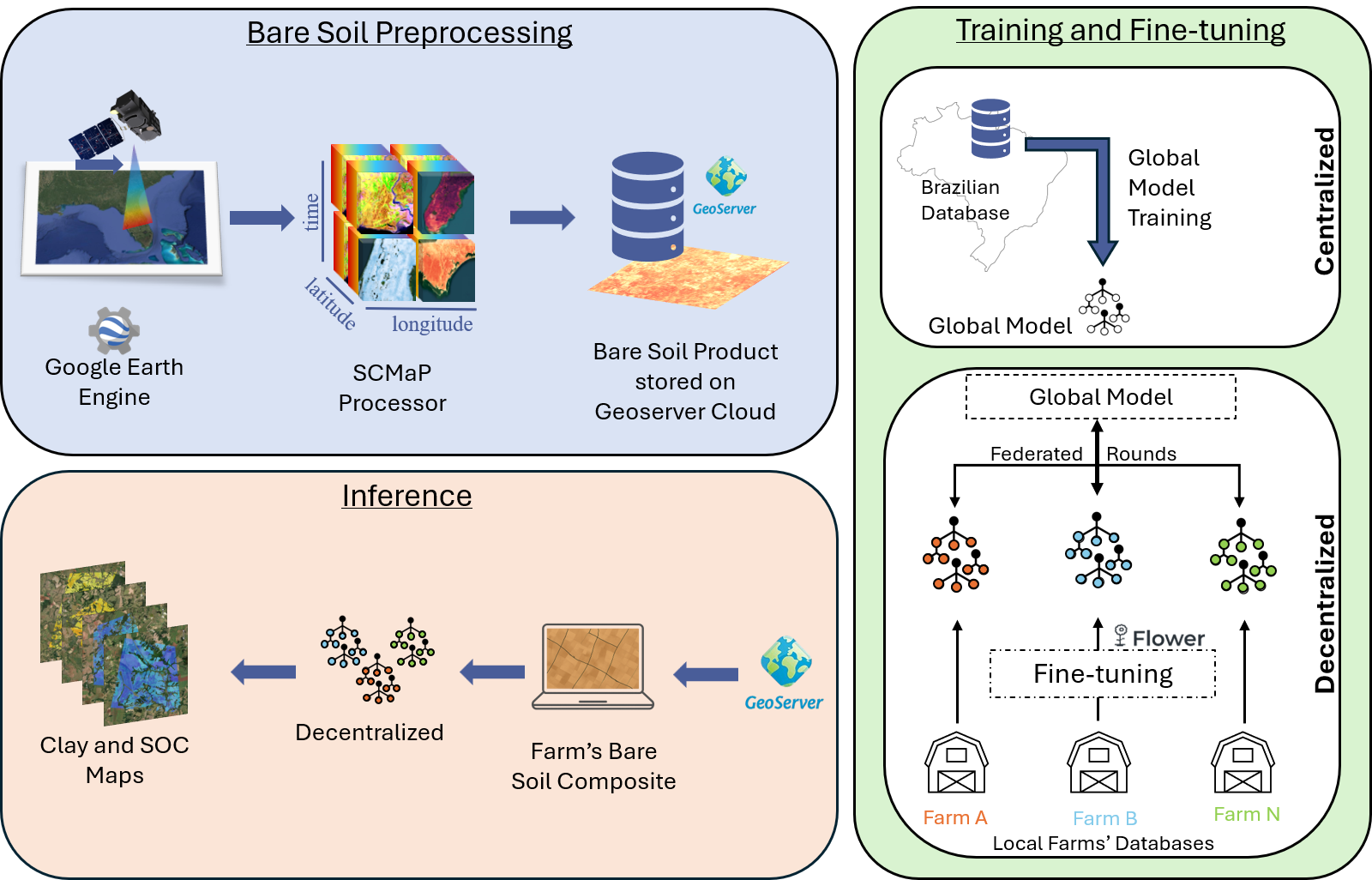
- Sentinel-2-style bare-soil composites and geospatial covariates
- Federated learning that exchanges model updates rather than pooled raw datasets
- Farm-scale mapping, sampling prioritization, and dashboard integration
Deliverables
- Privacy-governed collaboration workflow
- Local and shared model benchmarks
- Clay, texture, and soil organic carbon mapping outputs
- Validation, uncertainty, and provenance notes
- Dashboard-ready layers and reproducible reporting components
Evidence and Status
The work is presented as collaborative applied research and platform development. Public material demonstrates the workflow and related published research; it is not presented as a completed commercial deployment for every geography.
Institutional Relevance
The approach is relevant to multi-partner soil networks, land-sector programmes, research consortia, and MRV teams that must balance collaboration, data sovereignty, local adaptation, and interpretable delivery.
Limits and Next Steps
Performance depends on partner data quality, local calibration, spectral and EO availability, governance agreements, and the intended scale. Raw data remain under partner control, and operational or crediting use would require additional local and institutional review.